Applegate Public Meeting Sparks Conversations About Community Wildfire Preparedness
By Charlotte Hyde
On a chilly evening in January, the Applegate Community Church was packed. Rather than to worship, this crowd had come together to focus on a topic that features heavily on the minds of landowners across the Applegate: fire. That night, more than fifty community members, plus representatives from several local organizations, gathered to discuss the ongoing update process of the Applegate Community Wildfire Protection Plan (CWPP). The CWPP update is a multi-year project led by the Applegate Partnership & Watershed Council (APWC), with expertise from Southern Oregon Forest Resilience Collaborative (SOFRC) and A Greater Applegate (AGA). The project is funded by a US Forest Service Community Wildfire Defense Grant.
The January 20th meeting at the Applegate Community Church was the most well-attended of the five Applegate CWPP meetings held in January. This was the second round of CWPP public meetings, the first of which was held in October 2025, while the third and final round will be held in April 2026. Each round of meetings hits five communities across the Valley: Applegate, Murphy, Ruch, Wilderville, and Williams. The second round of meetings built upon activities conducted in the first round, like displaying the results of a community mapping exercise and showing how public input will be incorporated into the CWPP.
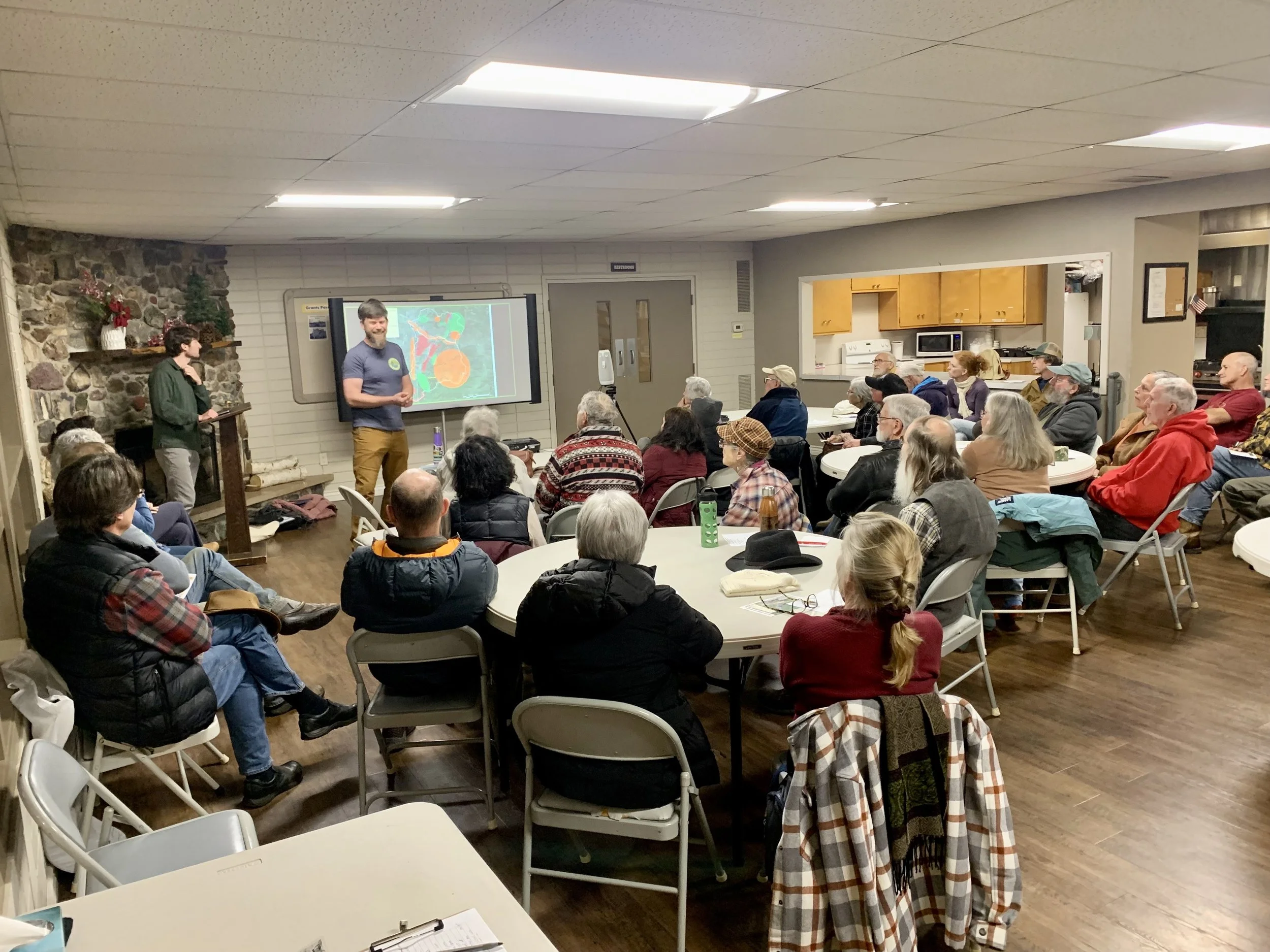
Applegate residents gather at the Applegate Community Church for a CWPP Public Meeting. January 20, 2026. Photo by APWC staff.
A prime example of how public input will be integrated into the CWPP is through the CWPP public survey. This survey, which can be accessed below, asks community members to reflect on their level of emergency preparedness, values related to wildfire protection, and perspectives on fuels management work. It’s important to note that the analysis process assumes that highly ranked community values (such as safety, biodiversity, or water quality) could benefit from appropriate fuels reduction projects. Giving a value a high score indicates that you want to prioritize that value for wildfire risk reduction. Data collected from this survey will be used to inform the resources, advice, and proposed projects included in the CWPP document. Between the October and January meetings, the initial responses to the CWPP public survey were analyzed with Vibrant Planet, a powerful mapping tool that informs land management and wildfire resilience planning decisions. These results were displayed at the January meetings as maps of the five Applegate neighborhoods, superimposed with layers of priority zones and proposed projects.
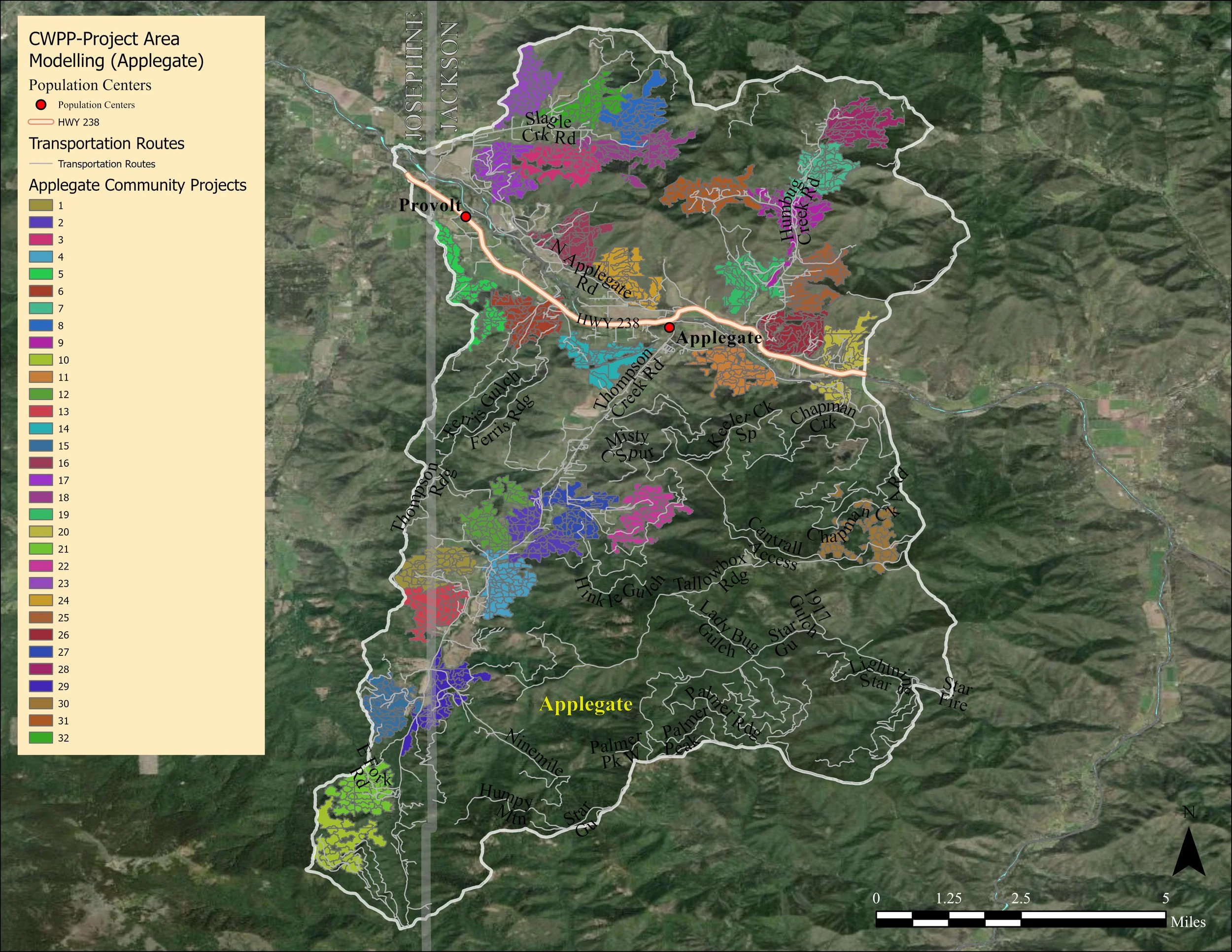
Proposed fuels treatment project areas in the Applegate neighborhood. Project areas were identified based on public survey results.
Similar to how they showed up in droves for the public meeting, Applegate residents were well represented in the public survey, making up 45% of respondents. Survey findings showed a strong majority support for wildfire risk reduction treatments, such as fuels treatments and defensible space work. When broken down by community, Applegate-based respondents in particular denoted “my community” as being at greater risk from wildfire than personal homes. Echoing these findings, a poll taken during the meeting showed that the vast majority of attendees have signed up for emergency alerts, created an evacuation plan, and done some form of defensible space or home hardening work on their property.
Aside from the presentation of this data, perhaps the most valuable part of the Applegate public meeting was the lively discussion brought on by engaged community members. The questions and perspectives encompassed the broad range of fire-related concerns present in our community’s collective consciousness. Several attendees expressed concerns about their homeowner’s insurance skyrocketing or being canceled, prompting a deeper conversation about this valley-wide issue. Others emphasized that, given the fact that 70% of the Applegate is public land, the management of not only private, but public land, is necessary for effective wildfire risk reduction. This provided an opportunity to wrestle with the complexities involved in addressing a landscape-level issue on a checkerboard of private and public lands, particularly given the all-around scarcity of financial resources.
When one resident asked if all projects proposed in the CWPP will be implemented, clarification was provided that rather than a to-do-list, a CWPP is a strategic tool that will be used by different community stakeholders in different ways. Among other uses, the CWPP will help fuels reduction implementors, like APWC, government agencies, and local fire districts, by elevating potential priority project areas, their estimated costs, and proposed treatment methods. This resource will inform what projects are prioritized in grant applications. In addition, the Applegate Fire District will use the CWPP to plan emergency response efforts, such as establishing safe gathering areas for evacuated residents, or preparing to stage firefighting resources. Applegate residents will be able to refer to the CWPP for advice about home hardening, emergency preparedness, and other fire-related topics. Even further, the CWPP update may help to reduce or prevent hikes to homeowner’s insurance rates.
The lively discussions at the Applegate meeting were made richer by the presence of Jack Shipley, one of the authors of the Applegate’s original Community Wildfire Protection Plan. Written in 2002 with Sandy Shaffer and Diana Coogle, the original Applegate Fire Plan was the first of its kind in the nation. You read that right - the first version of this now widespread planning tool came out of the Applegate. While CWPPs have been adopted nationwide and are now a prerequisite for government-funded forestry and fuels reduction projects, the impetus for the original Applegate CWPP was an observation of a community-wide lack of awareness and communication regarding wildfire-related risks. In creating this plan, Jack and his co-authors aimed to bring the community together in a dialogue about the role of wildfire in the ecosystem, how changing environmental conditions, such as a century of fire exclusion and the spread of invasive plants, are changing wildfire behavior, and how to address these challenges. The plan was formed through community meetings, landowner outreach, and conversations with government agencies, resulting in a comprehensive document that detailed the natural history of the Applegate Valley and provided resources for landowners. In the 24 years since the Applegate Fire Plan was developed, conditions in the Applegate have only gotten more complex, with ever-growing fuel loads, widespread Douglas fir mortality, and homeowner’s insurance issues compounding existing challenges. Jack’s presence at this meeting, decades after beginning this influential project, is a testament to the commitment within the Applegate to meet these challenges head-on.
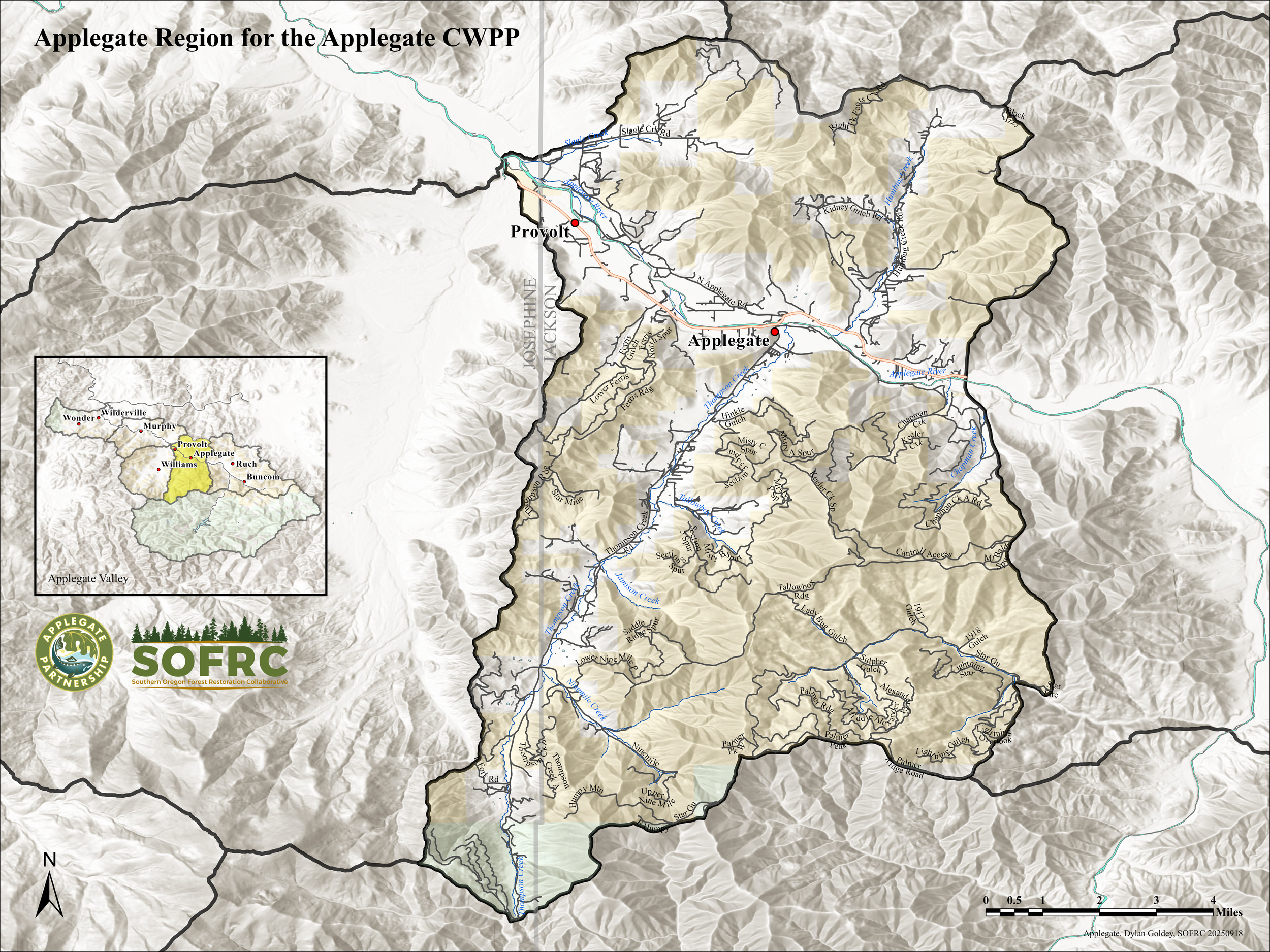
Map of the Applegate neighborhood within the greater Applegate Valley.
This meeting was one of many ongoing opportunities to have these kinds of important conversations. As the CWPP update progresses, there are still ways to get involved. You can complete the public survey and encourage others to do so as well. You can attend the third round of public meetings (dates and locations to be announced shortly), and sign up for the CWPP mailing list to receive announcements (sign up form located at the bottom of our blog page). Crucially, you can start the conversation at home with your family, friends, and neighbors about emergency preparedness and risk reduction practices. If the Applegate public meeting was any indication, community awareness and engagement in wildfire risk reduction is growing, and with it, so will community-wide resilience.
